
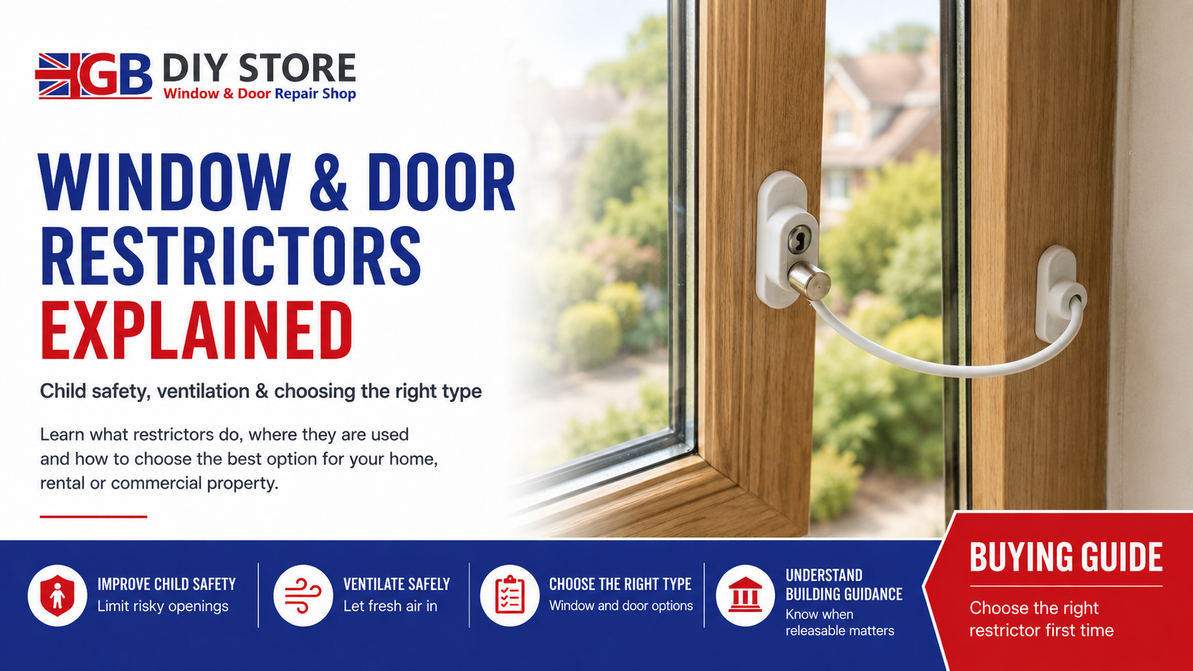
Window and Door Restrictors: Child Safety and UK Building Regulations
Restrictors are small, inexpensive devices that limit how far a window or door can open. They do two jobs at once: they keep a home ventilated on a warm day, and they protect against falls, which is why they matter most in homes with young children and in rented and commercial buildings where safety is a legal duty.
This guide explains what restrictors do, where the UK building regulations apply, and how to pick the right type for each situation. Our guide is written to help you decide what you need. When you're ready to buy, our window restrictors and door restrictors ranges are linked throughout.
Why restrictors matter for child safety
Falls from windows are among the most preventable home accidents involving young children, and most happen in warmer months when windows are left open for air. For more information make sure to read our Parent’s Safety Guide for a room-by-room breakdown.
A restrictor lets you ventilate a room while preventing the window from opening far enough for a child to climb or fall through. For children's bedrooms, the guidance is to fit restrictors that can only be released with a key or tool, so they can't be opened by the child but can still be opened quickly by an adult in an emergency.
The same principle applies to doors. A door restrictor stops a door swinging open too far, useful for stopping a heavy French or patio door catching the wind, and for keeping a controlled gap rather than a wide, unsupervised opening.
Where UK Building Regulations come in
In the UK, restrictor requirements depend on the type of building and how it's used rather than a single blanket rule. The key points to be aware of:
- New and replacement windows above ground-floor level are generally expected to have a means of limiting the opening, while still allowing the window to be fully opened for cleaning and emergency escape.
- Emergency escape windows must still meet minimum openable dimensions, so any restrictor needs to be releasable; permanent fixing isn't appropriate where the window is also a fire escape route.
- Rented and public buildings (including HMOs, care settings and schools) carry a duty of care that often makes restrictors effectively mandatory, particularly above ground level.
Because the detail varies by property type and by local authority, treat this as a starting point and check the current Approved Documents or speak to your building control body if you're working to a specific spec. If you're a landlord or maintenance buyer fitting in volume, our team can help you choose a consistent, compliant option; call 01623 622205.
Choosing the right window restrictor
Different windows need different mechanisms:
- Casement windows most commonly use cable restrictors, which hold the window at a safe gap but release for full opening when needed.
- Tilt-and-turn windows use a dedicated restrictor that works with the dual action of the window.
- Sash windows need a restrictor matched to the vertical sliding mechanism so the look of the window is preserved.
You'll also choose between automatic restrictors (which engage on their own as the window opens, good where you don't want to rely on remembering) and key-released types (which give maximum control for children's rooms). You can compare the options on our window restrictors page or read our guide for parents here.
Choosing the right door restrictor
For doors, the door type decides the restrictor:
- French doors are hinged, often heavy, and catch the wind, so they need a robust hinged-door restrictor with enough holding power.
- Patio (sliding) doors need a restrictor designed for the track, rather than a hinged mechanism.
- Bifold doors fold rather than swing, so they take a specialised restrictor that works with the folding action.
Our door restrictor range covers French, patio and uPVC doors. For door security add-ons that overlap with restriction, such as hinge protectors and additional locks, see additional locks & restrictors. For the practical side of fitting a hold-open restrictor to French and patio doors before summer, our summer door guide walks through it.
Permanent vs releasable
A permanent restrictor offers the most security because it can't be removed without tools, which is ideal for high-risk spots. The trade-off is access: permanent fittings can complicate cleaning and, crucially, emergency escape. As a rule, use releasable (key or tool) restrictors anywhere the window or door doubles as a fire escape, and reserve permanent fittings for situations where escape isn't a factor.
Getting it right for your home
If you tell us the window or door type and the room it's in, we'll point you to the right restrictor, and the right number of them, before you order. Call 01623 622205 or send us a message. All prices include VAT; orders placed before 3 pm ship the same day, and delivery is free on orders over £75.
Recent Posts
-

Types of uPVC Door Hinges: How to Identify Yours
Working out the type of uPVC door hinges you have is the job standing between you and a repair that …10th Sep 2026 -
How to Measure Window Hinges and Friction Stays
Knowing how to measure window hinges properly is the difference between a stay that drops straight i …10th Sep 2026 -
How to Adjust uPVC Door Hinges: Fixing a Dropped or Sticking Door
If you know how to adjust uPVC door hinges, most of the faults that make a door feel past its best t …10th Sep 2026