
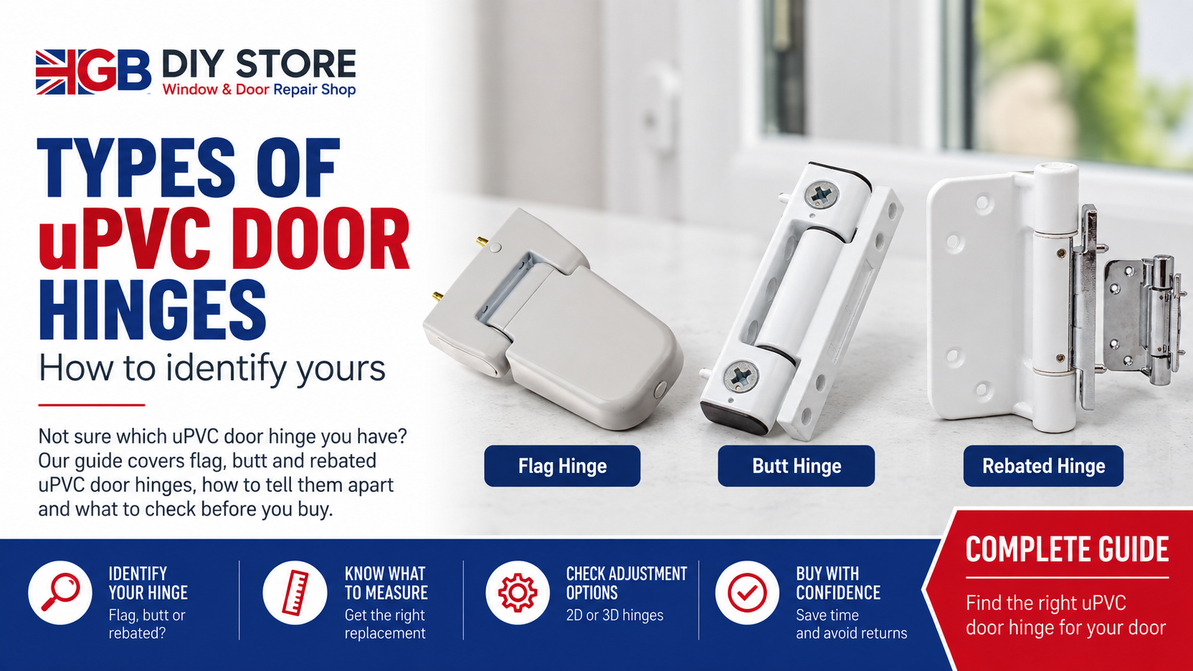
Types of uPVC Door Hinges: How to Identify Yours
Working out the type of uPVC door hinges you have is the job standing between you and a repair that takes ten minutes. Get it right, and the replacement drops into the same fixing holes. Get it wrong, and you're left with a door propped open on a kitchen chair, a hinge that won't line up or some other headache.
Here's the tricky bit. uPVC and composite doors have carried several different hinge patterns over the several decades, and almost none of them are stamped anywhere you can see without taking the door off. So this guide does it the other way round: it starts with what you can see while the door is still hanging, and works back to the part number.
Start With the Type, Not the Brand
Nearly every uPVC and composite door hinge belongs to one of three families: flag, butt, or rebated. Identify the family first and everything after it gets easier, because the family decides which measurements matter and which ones you can ignore.
Open the door about halfway and crouch down so you're level with the middle hinge. You're looking at the part that spans the gap between the frame and the door. That shape tells you almost everything.
Flag Hinges
A flag hinge is named for its shape. When the door is open, the body of the hinge sits to one side of a single vertical pin, so it looks a bit like a flag flying from a pole. It's the pattern you'll find on the majority of uPVC doors fitted in the last few decades.
Flag hinges come in two-part and three-part versions. A two-part hinge has one section fixed to the frame and one to the door. A three-part hinge splits one of those sections into two, which usually means it carries more weight and offers more adjustment. Both fit the same basic way.
What to look for: a single pin running top to bottom, a body that's noticeably deeper on one side of the pin than the other, and usually a small cap at the top or bottom of the pin hiding an adjustment screw. Common examples on our shelves include the Trojan Patriot Plus uPVC door flag hinge, the Avocet MT3D uPVC door flag hinge and the Yale Paddock Neon 3D flag hinge.
Butt Hinges
A butt hinge uses two leaves that fold together into a cylinder, the same principle as the hinges on your internal doors, but built to carry more weight. They're the pattern you'll most often meet on composite doors, where the slab is heavier, and the frame needs a broader bearing surface.
What to look for: two flat leaves rather than one offset body, and a knuckle in the middle where they meet. From the outside with the door closed, a butt hinge often shows as a neat cylinder rather than a squared-off block. The Era Laird Challenger composite door butt hinge and the Avocet uPVC door butt hinge are typical of the family.
Rebated and Pendulum Hinges
The third family fits spaces where the door doesn’t sit flush inside its frame. On a rebated door, the slab steps over the frame rather than closing into it, so the hinge has to bridge a different shape. Fit a flush hinge to a rebated door, and it won't line up.
How to tell which you've got takes two seconds. Close the door and look at the join from outside. If the face of the door and the face of the frame sit level with each other, the door is flush. If the door laps over the frame and casts a small shadow line, it's rebated. Our Pendulum rebate butt hinge is the standard answer for the second one.
2D or 3D: How Much Adjustment You Have
Once you know the family, the next question is how much adjustment the hinge offers, because this decides whether a sticking door needs a new hinge or just a screwdriver.
- 2D hinges adjust in two directions, but the two aren't the same on every hinge. Some give lateral and compression, others give lateral and height, and some eccentric-pin butt hinges combine movements in a single adjuster. Check what your pattern actually offers rather than assuming.
- 3D hinges normally give all three as independent adjustments: lateral, height and compression. One thing worth flagging: height is not the cure for a locking-side corner that has dropped. That needs lateral realignment to bring the door back into square, or toe-and-heeling if the hinges can't reach.
Look for the screw caps. A 3D hinge normally has an adjustment point at the top or bottom of the pin as well as on the body. If you can only find adjusters on the body you're probably looking at a 2D hinge, though you'll still need to work out which two directions yours gives you. Our guide on how to adjust uPVC door hinges walks through each adjustment.
What to Measure Before You Order
This is where most wrong orders happen, so it's worth being methodical. Take these four measurements in millimetres, and photograph the hinge while you're there.
- Overall height of the hinge body, measured top to bottom with the door closed.
- Fixing centres, meaning the distance between the centres of the screw holes on the frame side and again on the door side.
- The number of fixings on each side, and whether they're standard screws or hex-headed.
- The gap between the door and the frame at the hinge, which tells you how deep the hinge body needs to be.
It sounds obvious, but measure a hinge that's still fitted and straight rather than the one you've just wrestled off the door. A hinge that has been forced is rarely the shape it started as, and it'll give you a reading that fits nothing.
Which Way Does Your Door Open?
Some door hinges are universal, and some are handed, meaning there's a left version and a right version. In the UK, ‘handing’ describes where the handle is placed as you stand outside the door looking at it. If the hinges are on your left as you face the door from outside, it's a left-hand door.
Write the handing down before you start, because it's very easy to lose track of once the door is off and leaning against the wall. If a product listing doesn't mention handing, the hinge is universal, and you don't need to worry about it.
Composite Doors Are a Different Weight Class
A composite slab is substantially heavier than a uPVC one, and its hinges are specified to match. If your door is composite, check the weight rating on any hinge before you buy, and don't be tempted to fit a lighter uPVC pattern because the holes happen to line up. The extra mass will find the weak point soon enough, usually as a door that drops within a season.
Our composite door hinges are listed separately for exactly this reason. If you're not certain which material your door is, tap it firmly near the middle.
A composite door sounds solid and dull
A uPVC door sounds hollower and lighter.
A Word on Security
Hinges are a key part of a door's security, not just its movement. On an outward-opening door in particular, the hinge side is worth a second look, and some hinges are tested to higher security standards as a result.
If security is the reason you're replacing your hinges, check the product listing for a stated standard rather than assuming, and pair the work with a look at your door locks while the door is off.
Shop Door Hinges with GB DIY
Once you know the family, the measurements and the handing, ordering is the easy part. Browse our full range of uPVC door hinges, composite door hinges and the wider door hinges category, all dispatched same day when you order before 3 pm.
Still not sure what you're looking at? Send us a photograph with something for scale next to it, a tape measure or a coin will do, and we'll tell you what it is. You can find out how to contact us here. We'd far rather spend two minutes identifying it properly than process a return.
uPVC Door Hinge FAQs
How do I know if my uPVC door hinge is 2D or 3D?
Count the independent adjusters. A 3D hinge normally offers lateral, height and compression separately, with the height adjuster usually under a cap at one end of the pin. A 2D hinge gives you two of the three, and which two varies by pattern: some combine lateral and compression, others lateral and height, and some eccentric-pin butt hinges combine movements in a single adjuster. Check the product listing or the hinge itself rather than assuming.
Can I replace just one hinge, or do I need to do all of them?
You can replace one, and it's fine to do so if the others are sound. Do check that the replacement is the same pattern and depth as the ones staying put, because a hinge that sits even slightly differently will pull the door out of line. If two of three have failed, replace the set.
Are uPVC door hinges universal?
No. Fixing centres, body depth and handing all vary between patterns, which is why measuring matters more than matching the look. Some individual hinges are sold as universal and will suit doors opening either way, but the family and the measurements still have to match.
What is the difference between a flag hinge and a butt hinge?
A flag hinge has a single pin with the hinge body offset to one side, so it resembles a flag on a pole when the door is open. A butt hinge has two flat leaves that fold together into a central cylinder. Flag hinges are more common on uPVC doors and butt hinges on composite doors, though both appear on both.
Recent Posts
-

Window Sealant or Window Seal? What's Gone Wrong | GB DIY
If you have been looking for how to replace window sealant, there is a fair chance the part you need …6th Oct 2026 -
Types of uPVC Door Hinges: How to Identify Yours
Working out the type of uPVC door hinges you have is the job standing between you and a repair that …10th Sep 2026 -
How to Measure Window Hinges and Friction Stays
Knowing how to measure window hinges properly is the difference between a stay that drops straight i …10th Sep 2026