
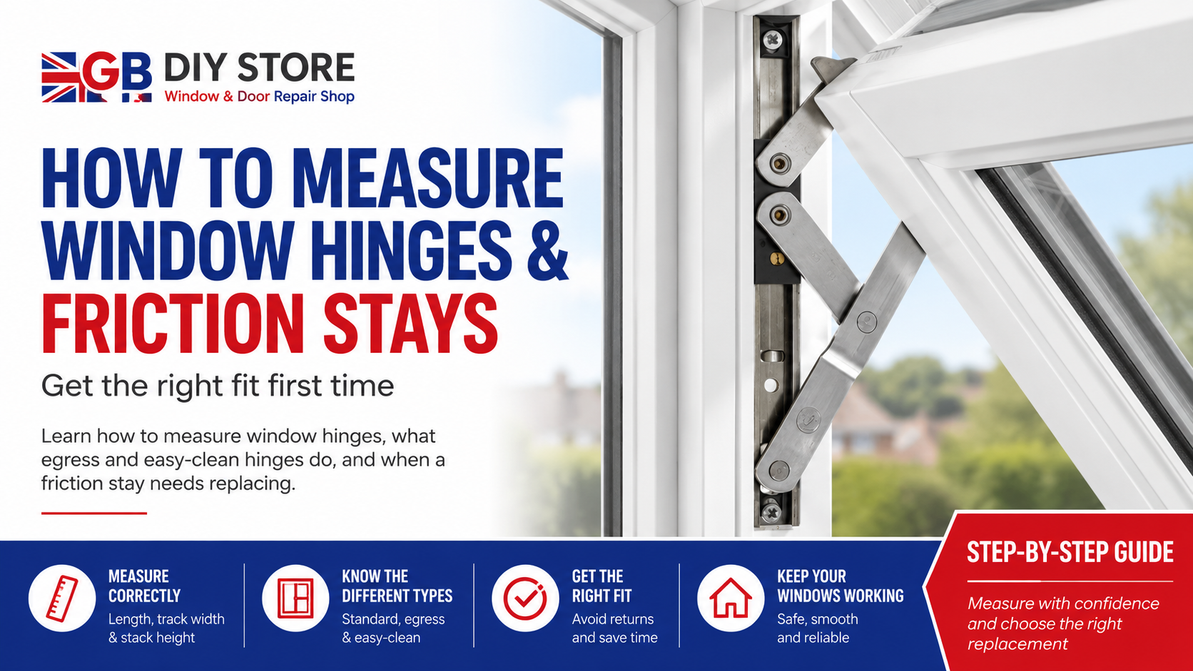
How to Measure Window Hinges and Friction Stays
Knowing how to measure window hinges properly is the difference between a stay that drops straight into the existing track and a parcel you have to send back. Window hinges, or friction stays as the trade calls them, look far more interchangeable than they are, and three windows in the same house can easily take three different sizes.
Here's something that catches people out: the length of the stay isn't the only measurement that matters, and it isn't even the one that most often causes a wrong order. This guide covers all three, plus the variants worth knowing about before you buy.
What a Friction Stay Actually Does
A friction stay is the arm assembly that lets a casement window swing open and then holds it where you left it. The friction part is doing work: it's what stops a window from slamming in a gust.
The stay sits in a track in the frame, with the arms fixed to the sash. That track is the reason measuring matters, because a stay that's the right length but the wrong track width simply will not fit.
First, Is Your Window Top Hung or Side Hung?
Before you measure anything, work out which way the sash opens, because it changes which stay you need. A top hung window is hinged along the top and pushes out from the bottom. A side hung window is hinged at one side, and swings open like a door. Stays are built for one or the other: opening angles and weight capacity differ between the two types, so a stay measured correctly but bought for the wrong type won't perform as it should.
Check each opener separately rather than assuming a whole window is the same. It's common for one frame to hold a large side hung casement with a smaller top hung vent above it, and those two take different stays.
The Three Measurements That Matter
Once you know which type you're dealing with, take all three measurements before you order, in millimetres, with the window open so you can see the whole assembly.
- Length of the stay, measured along the full track plate from one end to the other, not the length of the arm.
- Track width, meaning the width of the channel the stay body sits in. Ours are listed by track size, so the slimline window hinge friction stay with a 15mm track is a different part from a standard-track equivalent of the same length.
- Stack height, which is the thickness of the folded stay when the window is shut. Get this wrong and the sash either won't close flush or will stick out of the frame.
It sounds obvious, but measure the stay on the window you're actually replacing rather than the one next to it. Bay windows and top-openers frequently take different sizes from the main casements in the same room.
Egress and Fire Escape Hinges
An egress hinge, also sold as a fire escape hinge, is built so the sash swings clear of the opening rather than sitting in the middle of it. That gives you an escape route through the window in an emergency.
This matters because Building Regulations set out where escape windows are required in UK homes and what clear opening they have to provide. If you're replacing a stay on a first-floor bedroom, or on any window that serves as a means of escape, check whether the original was an egress pattern before you order a standard one. Our Yale egress fire escape window hinge is the standard replacement.
If you're not sure whether a window is an escape window, the safest assumption on a habitable upstairs room is that it is, and fitting the egress pattern costs very little more.
Easy-Clean Hinges
Easy-clean is more specific than it sounds, and the three patterns are worth separating properly. A standard side hung stay already moves the sash across towards the centre of the frame as it opens, and that movement is what gives you access to the outer face of the glass. A fire escape hinge behaves differently: it opens more like a door, swinging the sash right out of the way to give the widest possible clear opening. An easy-clean fire escape hinge does both jobs. It opens like a fire escape hinge, then has a button or release that lets the sash slide across into the cleaning position. Our Yale easy-clean fire escape window hinge is the pattern that combines the two.
Restrictor Hinges
A restrictor hinge limits how far the window opens, which is the standard answer where there are young children in the house or where a window opens onto a walkway. Our uPVC window restrictor hinge friction stay does the two jobs in one part.
Do read the two requirements together though. A window that needs to restrict for child safety may also be an escape window, and those pull in opposite directions. Our UK guide to window and door restrictors covers how to satisfy both, and the wider window restrictors range has more options for you to choose from.
Worn Out or Just Stiff?
Not every awkward window needs a new stay. Before you order, work out which of these you've got.
- The window opens but won't stay open, or drops under its own weight: the friction has gone and the stay needs replacing.
- The window is stiff throughout its travel but holds position fine: usually dirt in the track, and a clean plus a suitable lubricant often sorts it.
- The sash catches on the frame at one corner: check the stay for a bent arm, which happens when a window is forced in the wind.
- The window closes but won't lock: that's more likely the handle or the locking mechanism than the hinge. Our guide on how to identify uPVC window handles is the place to start.
One thing worth saying plainly: replace friction stays in pairs on the same sash. A new stay on one side and a worn one on the other will twist the sash, and you'll be back replacing it within months.
Shop Window Hinges with GB DIY
Once you know whether the window is top or side hung and you have the length, the track width and the stack height, ordering is straightforward. Browse our uPVC window hinges and the wider window hinges range, including egress, easy-clean and restrictor patterns, with same-day dispatch before 3 PM.
If the measurements aren't lining up with anything on the site, send us a photograph of the stay with a tape measure alongside it. We've seen most of what's out there, and can help you identify what you need the first time round.
FAQs
What is a friction stay?
A friction stay is the hinge assembly on a uPVC casement window. It lets the sash swing open and uses built-in friction to hold it in position, which is what stops the window slamming shut in the wind. A window that no longer stays where you put it has usually lost that friction.
How do I measure a window hinge?
Start by identifying whether the window is top hung or side hung, because opening angles and weight capacity differ between the two. Then take three measurements in millimetres with the window open: the length of the stay along its full track plate, the width of the track it sits in, and the stack height, which is how thick the folded stay is when the window is closed. All three have to match, and so does the window type.
What is an egress hinge?
An egress hinge, sometimes called a fire escape hinge, swings the sash clear of the opening so a person can get through the window. It's fitted where a window serves as a means of escape under Building Regulations, and it should be replaced like for like rather than swapped for a standard stay.
What is the difference between an easy-clean hinge and a fire escape hinge?
A fire escape hinge opens the sash like a door to give the widest clear opening, so someone can get out through the window. An easy-clean fire escape hinge opens the same way but adds a button or release that lets the sash slide across into a cleaning position. A standard side hung stay already moves the sash towards the centre as it opens, which is enough for cleaning on its own.
Do window hinges need replacing in pairs?
On the same sash, yes. Fitting one new stay against one worn one puts the sash out of true and shortens the life of the new part. Replacing both sides at once costs a little more and saves doing the job twice.
Recent Posts
-

Window Sealant or Window Seal? What's Gone Wrong | GB DIY
If you have been looking for how to replace window sealant, there is a fair chance the part you need …6th Oct 2026 -

Types of uPVC Door Hinges: How to Identify Yours
Working out the type of uPVC door hinges you have is the job standing between you and a repair that …10th Sep 2026 -
How to Measure Window Hinges and Friction Stays
Knowing how to measure window hinges properly is the difference between a stay that drops straight i …10th Sep 2026