
Window Sealant or Window Seal? What's Gone Wrong | GB DIY
If you have been looking for how to replace window sealant, there is a fair chance the part you need is not sealant at all. Three quite different things get called sealant; they fail in different ways, and only one of them is a part you can push into place yourself in ten minutes.
Here's the tricky bit. All three produce similar symptoms, so a cold draught or a damp sill tells you something has gone wrong, but not what. This guide sorts out which is which, so you order the right thing the first time.
The three things people call sealant
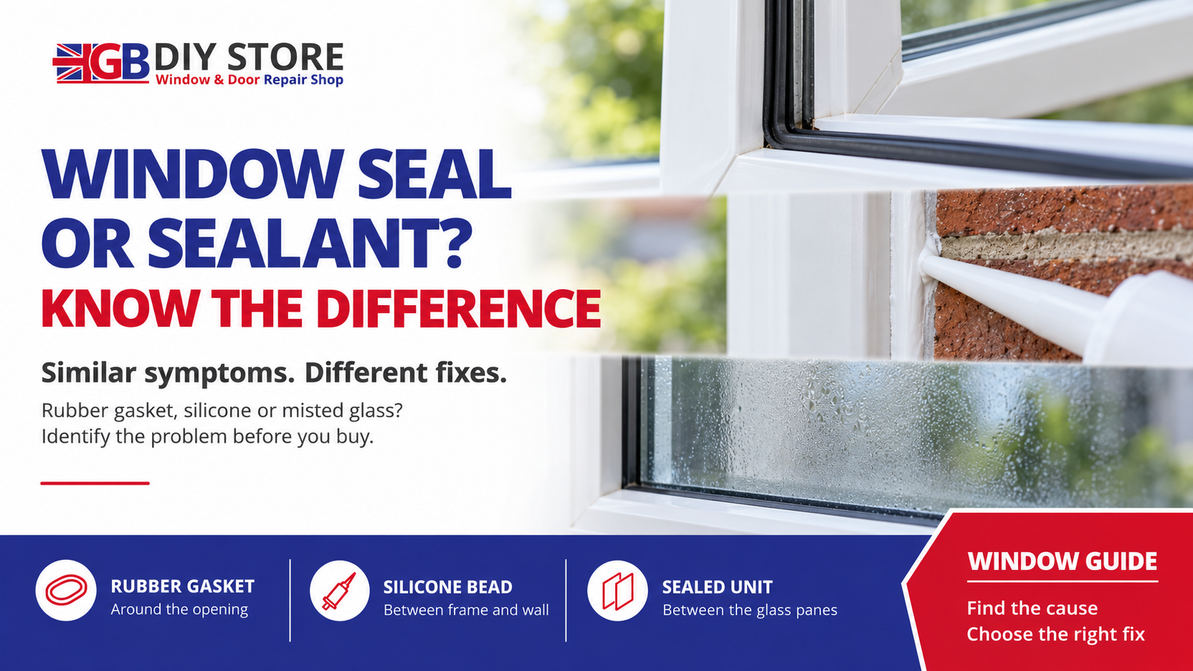
Stand at the window, and there are three separate seals in front of you, doing three separate jobs.
The rubber gasket. A continuous strip of black or white rubber that runs around the opening sash, or sits between the glass and the frame. This is a replaceable part, sold by the metre, and it pushes into a groove by hand.
The silicone bead. The line of sealant applied around the outside of the frame where it meets the brickwork. This is a wet-applied product, not a part, and it is what a builder means by sealant.
The sealed unit. The hidden edge seal holding the two panes of double glazing together. If this fails, the glass mists up, and no gasket or silicone will fix it.
How to tell which one has failed
Two minutes of looking will usually settle it.
Draught you can feel along the opening edge, or a sash that rattles. That is the rubber gasket. Run a finger around the seal with the window open. If it feels hard, flattened, or it has shrunk back from the corners, it has done its time.
Damp on the inside wall or plaster around the frame, with the window itself dry. That is the silicone bead outside. Look along the outside joint for gaps, cracks, or a bead that has come away from the brick.
A haze or droplets between the two panes that you cannot wipe off. That is the sealed unit. The glass needs replacing, and it is a glazier's job rather than a DIY one.
A useful check for the first one: close a sheet of paper in the window and pull it out. If it slides free with no resistance at one point along the frame but grips elsewhere, the seal is not meeting the frame at that spot.
Replacing the rubber gasket
This is the one most people can do themselves, and it is genuinely straightforward. Gaskets can be replaced. All you need to do is pull of its groove in one continuous piece, wipe the groove to remove any debris or dirt, and push the new length in by hand. No adhesive, and no tools beyond a pair of sharp scissors.
The part you need depends on the profile of your frame rather than the brand of window, which is why our Seal Centre starts with identification. If you would rather work through it step by step, our guide on how to replace the rubber seal on uPVC windows covers the whole job.
To measure your seals, measure all four sides of the opening sash, add them together, and round up. Fitting one length rather than four pieces matters, because the corners are where draughts start. Browse our window and door seals for bubble, flipper and wedge profiles.
The silicone bead outside
If the issue is with the outside bead, you are more than likely looking at replacing the silicone bead. To do this, the old bead has to come off completely, the joint needs to be clean and dry, and the new one inserted in one pass. It is worth doing on a dry day, and worth doing properly, because a bead applied over a damp or dusty joint will lift again within a year.
One thing worth saying: a fresh bead of silicone will not cure a draught coming through the opening sash. If the draught is where the window opens, the gasket is your answer, not the sealant.
Misted double glazing
If the misting is between the panes, the sealed unit has failed, and moisture has got inside. There is no seal you can buy to put that right. Instead, the unit needs replacing, which a local glazier can measure and fit, usually while the frame stays exactly where it is.
The good news? It has no bearing on the rest of the window. Handles, hinges and gaskets are all unaffected, so if those need attention you can sort them separately and at your own pace.
Shop replacement seals with GB DIY
Once you know it is the gasket, ordering is simple. Browse our full range of window and door seals, or start at the Seal Centre if you are not sure which profile you have. Everything is cut by the metre, in black or white, with same-day dispatch on orders placed before 3 pm.
Still not certain what you are looking at? Send us a photograph with a tape measure alongside it, get in touch here, or give us a ring on 01623 622205, and we will tell you which one you need.
Window sealant and window seal FAQs
What is the difference between window sealant and a window seal?
A window seal is the rubber gasket that runs around the opening sash or holds the glass in the frame. Sealant is the silicone bead applied outside where the frame meets the wall. The gasket is a replaceable part that pushes into a groove, and the sealant is applied wet and left to cure.
Can I reseal a window myself?
If you mean replacing the rubber gasket, yes, and it needs nothing more than sharp scissors. If you mean redoing the silicone bead outside, that is also within reach for most people, but it needs a dry day and a properly cleaned joint. If you mean a misted sealed unit, that is a glazier's job.
Why is my window still draughty after new sealant?
Because the sealant outside and the gasket inside do different jobs. Silicone seals the joint between the frame and the wall. The gasket seals the gap where the window opens. A draught along the opening edge will only be cured by replacing the gasket.
How do I know if my double glazing seal has gone?
Look for a haze or water droplets between the two panes that cannot be wiped off from either side. That is the sealed unit, not a gasket, and the glass unit needs replacing rather than resealing.
Related guides
- uPVC seal types: bubble, flipper or wedge
- How to replace the rubber seal on uPVC windows
- How to find and stop window and door draughts before winter
Recent Posts
-

Window Sealant or Window Seal? What's Gone Wrong | GB DIY
If you have been looking for how to replace window sealant, there is a fair chance the part you need …6th Oct 2026 -

Types of uPVC Door Hinges: How to Identify Yours
Working out the type of uPVC door hinges you have is the job standing between you and a repair that …10th Sep 2026 -

How to Measure Window Hinges and Friction Stays
Knowing how to measure window hinges properly is the difference between a stay that drops straight i …10th Sep 2026