

uPVC Seal Types: Bubble, Flipper or Wedge | GB DIY
There are fewer uPVC window seal types than the product listings suggest, and once you know which family you are looking at, the rest falls into place quickly. Nearly every gasket on a UK uPVC window or door belongs to one of four groups, and each one does a specific job.
It sounds obvious, but the reason seals get ordered wrongly is that they are easy to tell apart end-on and almost impossible to tell apart from the front. This guide gives you the distinctions that matter.
The two jobs a seal does
Before the families, the simpler division. Every seal in a window or door is doing one of two things.
Sealing the opening. A frame seal sits in a groove around the opening sash and compresses when the window or door shuts. This is what keeps weather and draughts out, and it is the one that fails first.
Holding the glass. A glazing seal sits between the glass unit and the frame or beading. Its job is to keep the glass secure and weathertight, and it tends to last longer because it is not compressed every time the window is used.
Work out which of those you need first, because it halves the options straight away.
Bubble gaskets
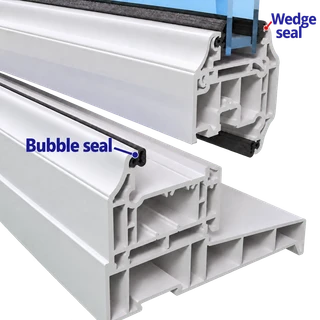
A bubble gasket is a frame seal with a hollow, rounded bubble along its length. The bubble squashes as the sash closes and springs back when it opens, and that springiness is what does the sealing.
It is the most common frame seal on UK uPVC windows and doors, and the usual answer to a draught along the opening edge. When one fails, it is because the bubble has gone hard, flattened, or the length has shrunk back from the corners. Browse our bubble gasket seals.
Flipper gaskets
A flipper gasket is also a frame seal, but instead of a hollow bubble it uses a flexible fin that folds over as the sash closes. It suits frames with a shallower groove, where there is not the depth for a bubble to compress into.
From the front, a fitted flipper looks much like a fitted bubble gasket. End-on the difference is obvious: one is a hollow tube, the other a solid flap. That is the check to make before you order, and the reason a sample pack is worth having.
Wedge gaskets
A wedge gasket is the glazing seal. It is a tapered strip that sits between the glass unit and the frame or beading, wedging the glass in place and keeping water out of the rebate.
You will usually only replace a wedge gasket if the glass has been out, or if water is getting in around the glass rather than around the opening. Browse our wedge gasket seals.
Bifold door gaskets
Bifold doors are the exception to everything above. The seals are specific to the door system rather than to a general profile, so an Aluk seal will not fit a Smart door and the other way round. Check the system name before ordering, and see our bifold door gasket seals.
How to tell which one you have
Open the window, and take a short piece of the existing seal out of its groove if you can. Then look at it from the cut end.
- A hollow, rounded top is a bubble gasket.
- A solid flap or fin is a flipper gasket.
- A tapered wedge shape, taken from beside the glass rather than the opening, is a glazing gasket.
- Look at the base as well. The arrowhead or dart that grips the groove varies between profiles, and it is as much a part of the fit as the top.
The surest method is to test samples directly in the frame, which is what our sample packs are for. Our Seal Centre covers the full identification process, including the profile codes.
Shop uPVC seals by type
All our gaskets are sold by the metre, in one continuous length, in black or white, and made to trade standard materials conforming to BS7412. Browse window and door seals for the full range, or go straight to bubble, wedge or bifold seals.
If you are replacing rather than identifying, our guide on how to replace the rubber seal on uPVC windows takes you through the job. If you are not sure the gasket is the problem at all, start with window sealant or window seal.
uPVC seal type FAQs
What are the main types of uPVC window seal?
Four. Bubble gaskets and flipper gaskets are frame seals, which seal the gap where the window or door opens. Wedge gaskets are glazing seals, which hold the glass in the frame. Bifold door gaskets are specific to the door system.
What is the difference between a bubble gasket and a flipper gasket?
A bubble gasket has a hollow, rounded top that squashes as the sash closes. A flipper gasket has a solid flexible fin that folds over instead. Both are frame seals, and the difference is only clear when you look at the seal end-on.
Are uPVC window seals universal?
No. The profile of the groove, the shape of the base, and the height of the seal all vary. A seal that is the right family but the wrong profile will either refuse to seat or fail to seal, which is why testing a sample in the frame is the reliable method.
Which seal do I need if water is getting in around the glass?
That is the glazing seal, so you need a wedge gasket rather than a frame gasket. If the water is getting in around the opening edge instead, it is the frame seal, which will be a bubble or flipper gasket.
Recent Posts
-

Window Sealant or Window Seal? What's Gone Wrong | GB DIY
If you have been looking for how to replace window sealant, there is a fair chance the part you need …6th Oct 2026 -
Types of uPVC Door Hinges: How to Identify Yours
Working out the type of uPVC door hinges you have is the job standing between you and a repair that …10th Sep 2026 -
How to Measure Window Hinges and Friction Stays
Knowing how to measure window hinges properly is the difference between a stay that drops straight i …10th Sep 2026